Sculptures on the sidewalk: public art and Denver’s downtown revival

Right now, Denver is booming. From all over the United States, people are flocking there. On a recent visit I heard different estimates of how many were arriving – several hundred people a week or even per day, depending on which Uber driver I was speaking to. People come for the good weather, the outdoors life and more recently for the recreational weed, which has legal since 2014.

The city hasn’t always been such a magnet of course. Like any place else, Denver has had its historical ups and downs. The oil price crash of the early 1980s and the recent slump from early 2015 bookend the transformation in the city’s fortunes over the last three decades and reflect how the local economy has diversified from its reliance on the energy sector. Going back to the 1980s and early 1990s, Denver’s downtown area was in a state of what appeared to be near terminal decline.

‘Imagine a Great City’
The influential former mayor, Frederico Peña, was pivotal in turning things around. He was elected on the back of a campaign slogan which boldly stated, ‘Imagine a Great City’, although it wasn’t until his second term that major capital projects such as the new airport and convention centre came to fruition.

But perhaps Peña’s most curious and brilliant initiative was the Denver Public Art Program, created by an executive order in 1988 and becoming a city law (or ‘ordinance’) three years later. The ordinance requires the city to set aside one percent of any capital improvement project with a budget of more than $1 million to finance public art. The stated purpose of the program was to ‘expand the opportunities for Denver residents to experience art in public places, thereby creating more visually pleasing and human environments.’ At the time, many critics scathed: ‘People are getting shot, why are you paying for art?’

Mayor Peña, however, had an instinct his detractors lacked. The introduction of the program suggests he was an early adopter of the notion that public art, especially when a part of broader regeneration policies, can help combat elements of social exclusion. On some level, he must have had faith that art could be transformative. It was about making downtown in particular a place that people would be drawn to visit again. One former head of the program, Michael Chavez, put the significance of the program like this: ‘It’s extremely important as our city is growing that art is included in design and planning of certain buildings. If you think about any great city in the world — London, Paris, New York — it’s not the sewers or the sidewalks people remember. It’s what the cities offer in art culture.’

Citizen participation
In fact, Denver’s program has more in common with say Newcastle than London, in terms of a strategy to systematically integrate art into place regeneration. The basic theory of how this works is twofold: firstly, public art can contribute to ‘place management and beautification, aimed at improving environmental quality and place attachment’; secondly, the actual production of artwork on this scale creates economic opportunities through jobs, materials and supply chains, just as with any piece of infrastructure.¹ This is a point not always so well grasped by critics who think that funding art is just a waste of money.

But where the city has really excelled has been in successfully involving its citizens and communities on the selection panels that commission winning artists from the numerous proposals that are received for any particular project. Being involved in this selection process gives residents a uniquely positive opportunity to shape their own neighbourhoods, in what John Grant, another former head of the program, described as the only ‘non-punitive interaction’ (i.e. not paying a parking fine) that many people have with the city.

Follow the bear
To date over 300 art pieces have been financed at a cost of nearly $32 million. The program has sparked plenty of debate and controversy along the way – both about high profile, individual artworks and the fundamental principle of tax dollars being spent on art. However, causing people to debate and engage with how their urban environment continually evolves is surely in itself a substantial benefit. The question of who pays of course is likely to persist.

In thinking about people’s diverse and often intense reactions to public art I’m reminded of Steve Jobs’ famous quote eschewing market research: ‘Customers don’t know what they want until we’ve shown them.’ No one ever said (except the artist) that what Denver’s convention centre really needs is a giant blue bear looking through the window. Yet the bear has become an iconic feature of a facility that’s been vital to expanding the local economy. The best street art most often seems to surprise us with its playfulness while at the same time making perfect sense in its specific context.

Similar commitments to public art now exist in other cities across the US and around the world, these days often with bigger budgets. But with a program still going strong after 25 years, Denver offers a fascinating case study of how the integration of public art in planning can potentially lay the foundations for urban renaissance.
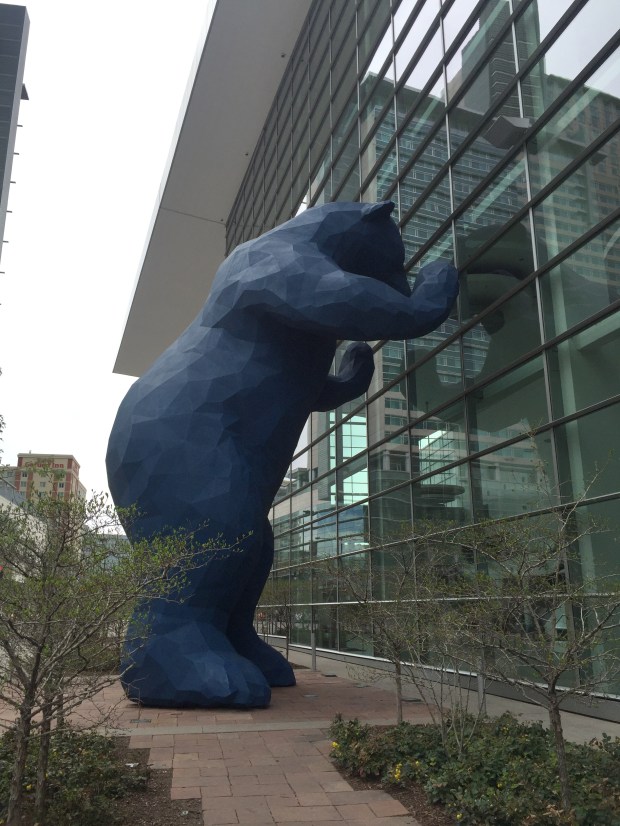
IMG_3122

‘I see what you mean’ by Lawrence Argent. Denver Convention Center


References and further links
1.Tornaghi, Chiara (2007). ‘Questioning the social aims of public art in urban regeneration initiatives. The case of Newcastle upon Tyne and Gateshead (UK),’ p.4. Accessed at:
http://www.ncl.ac.uk/guru/assets/documents/EWP42.pdf on 4 June 2016.

Browse Denver’s extensive public art collection at:
http://artsandvenuesdenver.com/public-art/denver-public-art-collection/

If you take a trip to Denver, check out http://www.denverfreewalkingtours.com for a really fun way to see the city and some great public artworks.

The living, breathing buildings of the 2050s

Can you imagine what a skyscraper will look like in 2050? That’s the question the Arup Foresight team set out to answer in a report released earlier this year. Their vision of a 2050s urban building includes an array of renewable technologies, a vertical farm for food production, modular building components and even robots that provide cleaning and maintenance. You can read a good overview of the technologies employed here. As Josef Hargrave, foresight consultant and lead author of the report admits, some features are far more plausible than others – he describes the design as ‘a hamburger of ideas’. But Arup’s sketch is not intended to be a prediction so much as an imagining of possibilities for skyscrapers in the 2050s. Significantly too, these potential components are rooted in key drivers of change that are hard to dispute: urbanisation, climate change and new patterns of food production to name only a few.

A living organism
It’s on a conceptual level however that this design points to a particularly intriguing direction. The urban building of the future will function ‘as a living organism in its own right’ with a structure that is ‘highly adaptive and characterised by indeterminate functions; a scheme where space and form are manipulated depending on the time of day or the user group currently activating it.’

This idea of mutability and adaptability suggests a paradigm shift in the way that the function of architecture is understood. Big infrastructure projects tend to lock society into pathways that can be hard to deviate from; and given their scale and cost big infrastructure is necessarily an investment with long term horizons. But with technology and society set to change more ever more rapidly over the next decades (think Kurweil’s law of accelerating returns), there’s a greater risk of fixed infrastructure becoming anachronistic, redundant or constraining more quickly.

It makes sense therefore for the 2050s urban building to integrate adaptability into the very fabric of its design. It’s like the advantage of having hardware that will accommodate software updates for as long as possible – although with its modular components, even this structure’s hardware can be altered. At a scale that’s micro in comparison, there are nonetheless already fascinating examples of flexible design at a domestic level that allows a user to control the space as daily needs dictate, or life circumstances change over time (see http://www.lifeedited.com).

Community integration and the future workplace
The 2050s urban building is also conceived as located very firmly in the public realm – fully integrated with its urban community and environment, yet entirely self-sufficient. This integration is a stark contrast from the privatised, isolated spaces of most skyscrapers today, where you won’t gain access past the reception desk without a pass or appointment.

Arup Foresight has done previous work on the future of offices so detailed speculation of how the space of this 2050s building might be used or inhabited appears beyond this project’s scope. But it’s natural to wonder how this highly adaptive building design might dovetail with workplace trends over the next few decades. Some argue we will continue to see the rise of small, nimble organisations and the decline in numbers of large corporations. If that projection does eventuate, we can reasonably expect to see more co-working spaces, shared by several small companies from different sectors and freelancers.

Grind in NYC is a fantastic illustration of a co-working space and the people who work there talk enthusiastically of its collaborative and inspirational benefits. Increasingly it seems that freelancers, who could be at home, value working around people. Highly adaptive and fluid designs will therefore hold even more appeal if the future of the workplace is typified by a high churn of different occupants and users – with needs more dynamic and diverse than those demanded by a monolithic company headquarters. The 2050s skyscraper will not so much be built to last, as built to change.

Arup are holding an event later today about challenging conventional thinking on the design of buildings in the 21st century. Entitled makingbuildingswork@Arup, it forms part of the GreenSky thinking programme of events running all this week:
http://www.greenskythinking.org.uk/programme13/arup.html

Off the Edge of History (and Planes That Fly Out of Computers)

Professor Anthony Giddens recently gave a lecture previewing his current work in progress, Off the Edge of History:the world in the 21st century, to a packed house at the London School of Economics, where he was director between 1997 and 2003. He received a rapturous reception, and not just because this was a sort of homecoming. His analysis of human development pathways into the 21st Century was both exhilarating  and alarming at the same time.

The Anthropocene

Gidden’s thesis is that the epoch we are living through is fundamentally distinct to any previous era in both geological and human history. Invoking the famous work of atmospheric chemist Paul Crutzen, we have moved from the Holocene Age to the Anthropocene Age  –  named so because human activity has by now influenced the world to such a degree that ‘nature is no longer nature’.  The extent of  human encroachment on ecosystems is unprecedented . As a consequence, Giddens argues, there are profound implications for how we think about our future and how we view our past.

Singularity

Yet the dawn of the Anthropocene Age is only half the story. While nature is no longer nature, humans are also no longer human; or at least the essence of being human is changing rapidly because of the convergent disciplines of nanotechnology, artificial intelligence and biotechnology. On this point Giddens draws heavily on the singularity literature. Technological singularity first emerged as a concept in the 1950s and can be loosely defined as  ‘the ever accelerating progress of technology and changes in the mode of human life, which gives the appearance of approaching some essential singularity in the history of the race beyond which human affairs, as we know them, could not continue’ (1).

The singularity movement has been popularised much more recently by futurist, inventor and Google director Ray Kurzweil, and in particular by his 2005 book The Singularity Is Near.  While advocates of singularity are not without their vociferous critics, Giddens suggests that attempting to assess the accuracy of Kurzweil’s predictions should not be the focus of our inquiry. Instead we must simply recognise that the 21st century is characterised simultaneously by both high opportunity and high risk.

Furthermore, at the extremes of this opportunity-risk spectrum are potential, and plausible, existential opposites: apocalypse on the one hand, through nuclear warfare or climate change; and immortality on the other, if we could pause the ageing process. These existential extremes are reflected in the dichotomy of perspectives in the literature about humanity’s future, which fall into either the optimist (e.g. Matt Ridley) or doomsdayer (e.g. Martin Rees) category. However, rather than adopting an optimistic or doomsdayer stance himself, Giddens is keen to emphasise that in the high opportunity/high risk society, opportunities and risks are always deeply entwined.

Where are our limits?

One critical implication of living in an age ‘off the edge of history’ is the serious epistemic challenge to the notion of sustainability. If sustainability is understood in terms of living within clear limits, Giddens asks how do we know what those limits really are, when they appear to be continuously shifting, pushed ever outwards by interventionist  technologies? He doesn’t give examples but there are many, with perhaps one of the most apparent being how improved extraction technologies have delayed predictions of peak oil production.

But surprisingly Giddens doesn’t  acknowledge  that the problem of knowing (or not knowing) where limits exist, manifests in both directions. In other words sometimes our sustainable planetary limits turn out to be much closer than previously reckoned, as with Arctic ice melt for example. In fact the drive for consensus among the several hundred contributing authors to the reports of the Intergovernmental Panel on Climate Change (IPCC) likely steers projections towards more conservative ranges. Certainly though,  defining sustainable limits appears considerably more complex and elastic than it once might have done, given an accelerating rate of technological advances.

Fuzzy horizons

How then should we proceed? Helpfully Professor Giddens offers a three point framework to help navigate a path through our high opportunity/high risk future:

  1. Never avoid risk by living in denial (unlike, broadly speaking, current approaches to climate change which are still largely characterised by denial; not necessarily of the reality of climate change per se but there’s a failure to appreciate the seriousness of its full impacts).
  2. Leave our Enlightenment thinking at the door. We must not expect to ‘march in and conquer the future’. Instead acknowledge the future’s ‘puzzling opacity’, which is brought about by the vast spectrum of opportunity and risk. I have renamed this opacity the ‘fuzzy horizons’ of the future.
  3. Backcasting will be as important as forecasting, because of the high level of risk now inherent in global society. Backcasting, a technique driven by climate change research, involves starting with a vision of a point in the future and working backwards, thereby facilitating the creation of alternate scenarios that avoid identified undesirable outcomes.

Printing systems

If that framework sounds too theoretical or vague to have much practical use, Giddens assures us of the opposite. Studying the high opportunity/high risk society will be the primary task of the social sciences this century. As an example, he cited research he has been doing on re-industrialisation and the re-shoring (as opposed to offshoring) of jobs in the US. In considering the impact of technological innovation on labour,  Giddens has examined 3D printing, a paradigm of a disruptive technology with wide ranging applications and the breakthrough potential to revolutionise manufacturing.

The team at MIT working on 3D printing are now focussed on trying to print whole systems rather than just objects. Printing entire systems enables the potential to print whole devices with myriad components. The lead researcher at  MIT has reportedly said he wants to design a plane that will fly directly out of a computer! The professor obviously hoped this anecdote would illustrate the risk/opportunity axis that 3D printing represents to the future of manufacturing although the recent media attention around the 3D printing of guns may have provided a starker case study.

Rational foundations

As our worldview comes to terms with this vast spectrum of risk and opportunity, Giddens returns again to the question of whether this new and altered age should inspire us with optimism or pessimism – but again he places it to the periphery just as quickly. He proposes that as long we have a rational foundation for our beliefs, either perspective can be accommodated justifiably. But  doesn’t  an appeal to rational foundations sound suspiciously like an Enlightenment ideal of the kind he warned us to be wary of previously?

My own difficulty with Giddens’ portrait of the high risk/high opportunity society is that he conflates rapid technological advancement with broader global megatrends. The opportunities and risks of nanotechnology, artificial intelligence and biotechnology are arguably roughly in proportion, though we will still require robust ethics and governance structures to develop and harness their benefits responsibly. In these endeavours, opportunity and risk are indeed tightly knotted.  But  there’s no upside to climate change – unless you wish to drill for oil in the Arctic, the risks far outweigh the opportunities. On the face of it then, constructing a rational foundation for pessimism is the easier task.

From risk to uncertainty

A more fundamental problem with Giddens’ thesis is the prominence he gives to risk, at the expense of uncertainty. Risks can be analysed, understood and managed. But as the systems thinker Thomas Homer-Dixon has consistently argued, we are moving from a world of risk to a world of uncertainty, which is typically characterised by unknown unknowns. This uncertainty arises from complex systems that have emergent properties, flip from one behaviour to another, and where the relationship between cause and effect is disproportionate. Complex systems, like the climate or the global economy, cannot be easily managed because their behaviour is unpredictable. Clearly Giddens himself implicitly recognises the function of uncertainty, as evidenced by his critique of sustainability discussed above and his reference to the future’s ‘puzzling opacity’.

This distinction between risk and uncertainty isn’t purely theoretical either. Gidden’s basic premise, that our current era is unchartered because of humankind’s novel contemporary relationship with nature and evolution, seems relatively incontrovertible. But an equally unprecedented hallmark of our time is the extent to which globalised systems are tightly coupled and interconnected as never before.  Too much interconnection, however, leads to less resilience, allowing contagion to spread more readily through a system – as amply demonstrated by the financial crash.

In a world experiencing frequent and increasingly severe shocks, Homer Dixon argues the balance of investment should move away from efficiency towards increasing resilience, by decoupling elements and increasing buffering. But in my view policy responses designed to increase resilience are more likely to be generated from a position that acknowledges profound uncertainty than through conventional risk management approaches. When I enquired at the end of the lecture, Professor Giddens kindly shared with me the fact that he’s familiar with Homer-Dixon’s work.  It’s curious then that Giddens doesn’t explore this ontological shift from risk to uncertainty in more detail.

Nevertheless, when published, Off the Edge of History promises to be a significant and highly engaging contribution to understanding  the unparalleled magnitude of human influence over our own and the planet’s destiny. And if the auditorium’s gripped reaction is anything to judge by, there’s an intelligent young audience willing to listen and think very seriously about the repercussions for all of us that such singular exertion may bring in the coming decades. That at the very least is a cause for optimism.

References:

  1. http://en.wikipedia.org/wiki/Technological_singularity